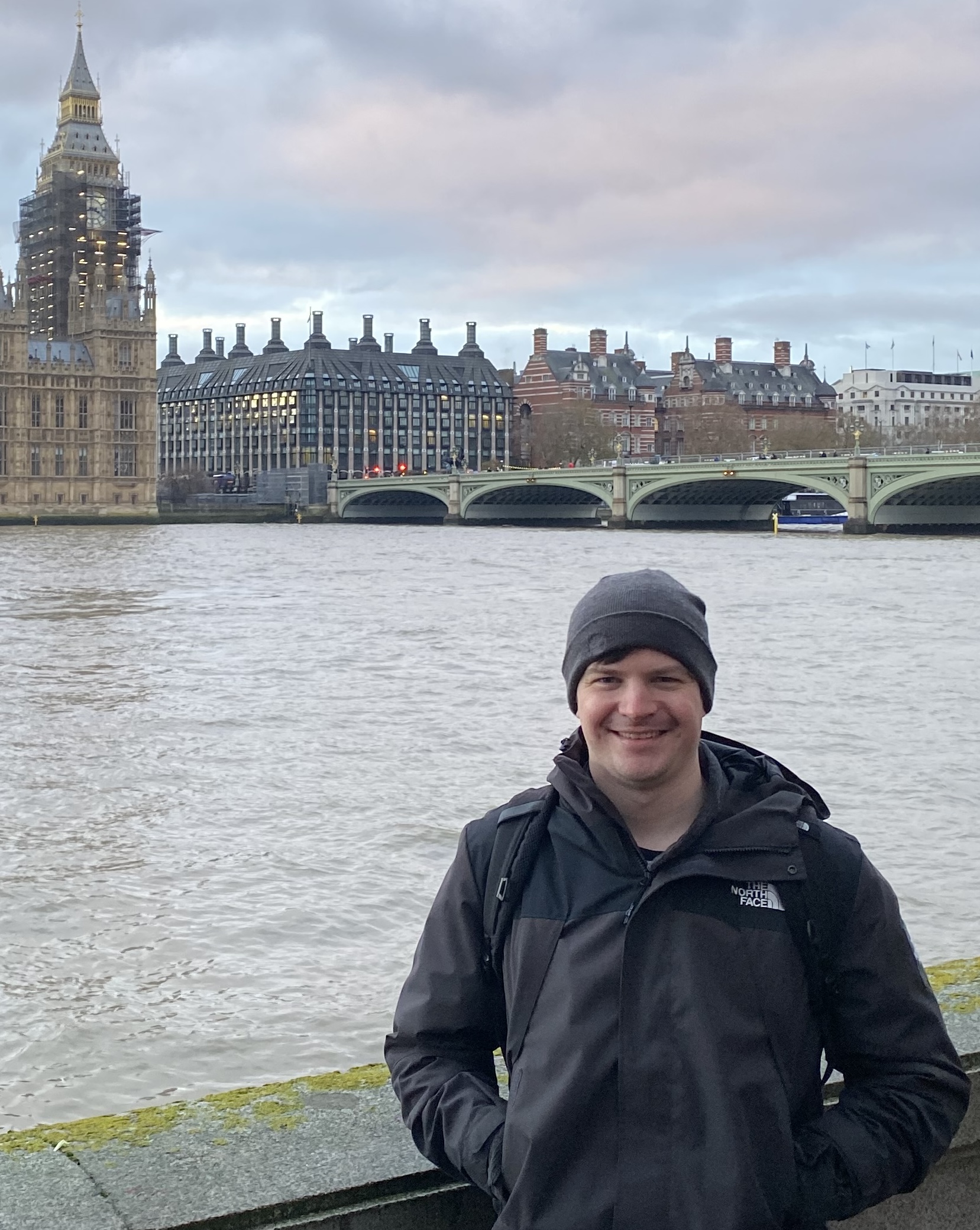
 CHARLES REDMON
[tʃɑɹɫz (ˈtʃɑɹli) ˈɹɛdmən]
Lecturer, Department of Language and Linguistics
Director, Speech Systems Lab
University of Essex
Wivenhoe Park, Colchester, UK
Email: first initial dot lastname at essex dot ac dot uk
CV: pdf
News
- Article
- My paper providing acoustic evidence for the merger of palatal and retroflex sibilants in Telugu has now been accepted at JASA Express Letters (link to follow shortly).
about me
I am a Lecturer (Assistant Professor) in the Department of Language and Linguistics at the University of Essex, working primarily at the intersection of phonetics, psycholinguistics, and computing, but also addressing questions in morphology, historical linguistics, and Germanic (thanks Aditi!). My research covers a variety of languages and language families, but my main focus is on the South Asian region. This work began during my Masters at EFLU in Hyderabad, and continues through active collaborations with researchers at Jadavpur University in Kolkata, IIT in Guwahati, and the North-Eastern Hill University in Shillong. More specifics on these research areas can be found below, as well as on my research page and at the Speech Systems Lab site. If you would like to work with me at Essex or collaborate on research please email me.
current teaching
- LG110: Fundamentals of the Human Speech System (Autumn Term, 2026)
- LG223: Speech Recognition (Autumn Term, 2026)
- LG117: Language and Computing (Spring Term, 2027)
- LG364: Forensic Linguistics (Spring Term, 2027)
- This module will be jointly taught with Nina Markl and Natalia Rodriguez Vicente
- LG415: Phonetics (Spring Term, 2027)
research areas
- Phonetics/Phonology
speech acoustics, production, perception, organization of phonetic and phonological systems, lexical contrast structure, models of coarticulation, phonetics of South Asian languages (incl. Malayalam, Telugu, Assamese, Garo, and Phom) - Morphology
morphological processing in the brain, asymmetries in derivation, morpho-phonological alternations in derivation, historical changes in morphological structure - Psycholinguistics
cue weighting, perception in noise, word recognition, priming, eye tracking - Neurolinguistics
lexical access and morphological processing in the brain, phonological encoding of speech - The Lexicon
modeling acoustic cue distributions among lexical contrasts, acoustic cues to higher-order structure, lexical encoding, information structure in the lexicon - Computing
physiologically grounded automatic speech recognition, building resources for underdocumented languages (particularly of Northeast India), structured open-access lexical databases, modeling opacity in orthographic systems - Complex Systems
language as a complex system, simulating acoustic perturbation of lexical contrasts, phonological and semantic networks, methods in statistical inference on network data structures